There's a specific small heartbreak that comes from watching a song you actually like get scrolled past in under two seconds. Most of our team has felt it. You make something in Sonx, you're proud of the chorus, you post it, and the view count parks itself at 211 like it's waiting for a bus. The natural conclusion is that the algorithm has a personal problem with you.
It almost never does. The usual culprit is the first two seconds, and the fact that nobody ever heard the chorus you were proud of, because it didn't arrive until 0:18 and the average person was gone by 0:02.
A song that works on short-form video is a different object than a song that works on the radio or on a Spotify playlist. Same ingredients, completely different shape. Once you can see the shape, you can describe it to an AI music app in a single sentence and get something built for the format on the first or second try. That's the whole point of this guide: the sentence, and what has to be true about the song that comes out of it.
What "TikTok-ready" actually means
Let's define the target, because "make it catchy" is not a spec. A TikTok-ready song is not a three-minute song trimmed down. It's a song designed front-to-back around a few hard constraints that short-form video imposes whether you like them or not.
The hook lands almost immediately. No four-bar intro, no slow build. The thing people came for is happening by the time the second second starts. The clip is short, the usable part is roughly the first 15 to 30 seconds, and often less. It loops, meaning the end of the clip leads cleanly back into the beginning so a repeat play doesn't feel like a hard stop. And it's mixed to survive a phone speaker in a noisy room, sound-on, competing with a thumb that is already moving.
Here's the same idea as a table, because the contrast is the actual lesson.
| Traditional / streaming song | TikTok-ready song | |
|---|---|---|
| Intro | 4–8 bars before the vocal | None, the hook is the intro |
| Structure | Verse → build → chorus | Chorus / hook first, then the rest |
| Length that matters | The whole 2.5–3.5 min | The first 15–30 seconds |
| Ending | A real outro or fade | Loops back to the start |
| Built for | Headphones, lean-back listening | A phone speaker, sound-on, mid-scroll |
If you've read our piece on how AI music generation actually works, you already know the app builds a song from a structured plan it writes off your prompt. The trick for short-form is to bias that plan toward the right column above, and you do it with the words you choose.
The one-sentence formula
Most people write prompts that are too vague to be useful. "A sad song." "Something for TikTok." The app fills in the blanks with the most average possible answer, because you gave it nothing to grab onto. A good prompt does the opposite: it's one sentence carrying four specific jobs.
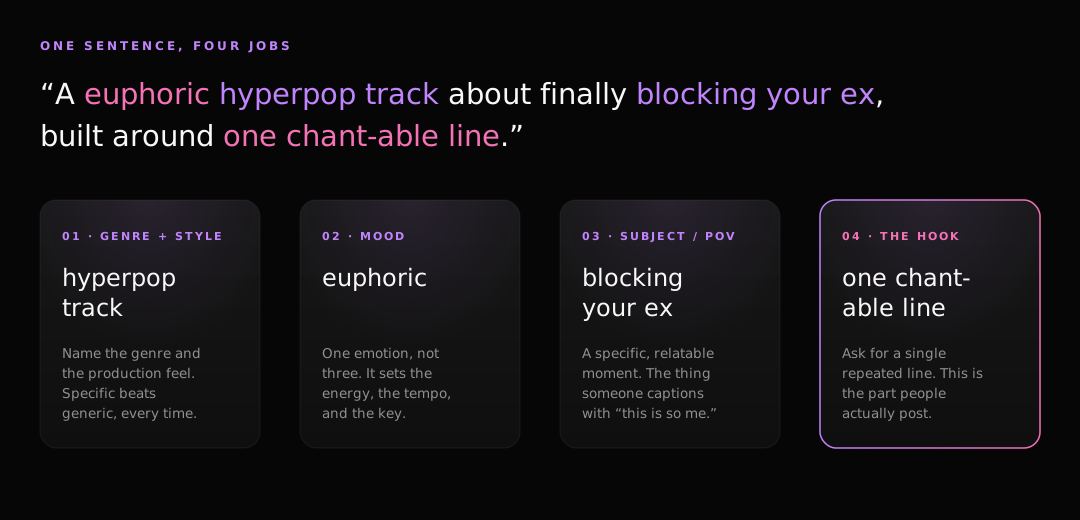
Genre and production style. Not just "pop," but the flavor: "hyperpop," "dark drill," "bedroom pop," "Jersey club." This is the single biggest lever you have, and it's why apps that nail prompt adherence feel smarter than they are. If you're not sure what to name, our genre list is a decent menu to steal from.
One mood. Pick a single emotion and commit. "Euphoric," "menacing," "wistful," "petty." One word does more work than three, because three moods average out into none. The mood quietly sets the tempo and the key before you've said anything about tempo or key.
A subject or point of view. The more specific and the more relatable, the better. "About missing someone" is fine. "About finding their hoodie six months later" is a post. Specificity is what makes a stranger comment "this is so me," and that comment is the entire game.
A hook directive. Tell the app to build the song around a single repeatable line. Phrases like "built around one chant-able hook" or "with a repeated title line" push the model to put a memorable phrase up front and bring it back, instead of scattering clever lines across a verse nobody will reach. A real musical hook is the thing that does the remembering for the listener.
Stack those four into one sentence and you've removed almost all the guesswork. The model still has plenty of room to surprise you, but it's now surprising you inside the lines you drew.
Front-load everything
Traditional songs earn the chorus. They open with an intro, lay down a verse, build a little tension, and pay it off when the chorus hits. It's a great structure for someone who has already decided to listen. It is a terrible structure for someone deciding, right now, in real time, whether to keep watching.
So invert it. The chorus, or at least the hook, goes first. The first thing anyone hears should be the best thing in the song. If you want the textbook version of what you're rearranging, the verse–chorus form is the thing you're deliberately breaking. You can ask for this directly in the prompt: "start on the hook," "no intro, vocals from the first beat," "chorus-first arrangement."
The other half of structure is the loop. Short-form platforms replay your clip automatically, and a clip that loops cleanly buys you a second and third play for free, which the algorithm reads as watch time. A clean loop means the last note of your usable section sits comfortably next to the first note. In practice you get this by ending the clip on the same energy you started it, not on a resolved, "the song is over now" chord. It feels like a circle, not a full stop.
The first thing anyone hears should be the best thing in the song. Everything else is negotiable.
Lyrics that get used, not just heard
The lyric that matters most is the one line people will lip-sync, caption, or stitch. You're not writing an album. You're writing one line good enough to borrow.
A few things that consistently work, from watching which of our own demos got reused and which died quietly:
- Be specific, not poetic. "I left my charger at your place" beats "echoes of you linger in my home." Concrete objects are sticky. Abstractions slide off.
- Repeat the hook. The line you want remembered should show up more than once, ideally early and again right away. Repetition is not lazy here, it's the mechanism. It's literally how an earworm works.
- Write a point of view, not a summary. "POV: you're getting ready to see them one last time" gives a stranger a role to step into. A line that just narrates gives them nothing to do.
- Mind the consonants. Hard consonants and short words punch through a phone speaker. Long, vowel-heavy lines turn to mush in exactly the listening conditions you're optimizing for.
You don't have to write any of this yourself, by the way. You can ask the app for the lyrics and then keep the one line that makes you go "oh, that's the one," and regenerate the rest around it. The editing instinct matters more than the writing.
The video is half the song
Here's the part people skip, and it's the part that decides whether the song ever gets a fair hearing. On a feed that is mostly video, the visual is what stops the thumb. The song is what makes them stay and what they take with them, but the song doesn't get a turn if the first frame didn't earn it.
So the song and the video have to be made for each other. Vertical, 9:16, filling the screen. Movement that lands on the beat, so the cut or the zoom hits when the hook hits. Captions on screen, because a meaningful share of people watch with the sound off until something makes them turn it on. If you want the official version of the platform's own advice, TikTok's Creator Academy says roughly the same thing in more words.
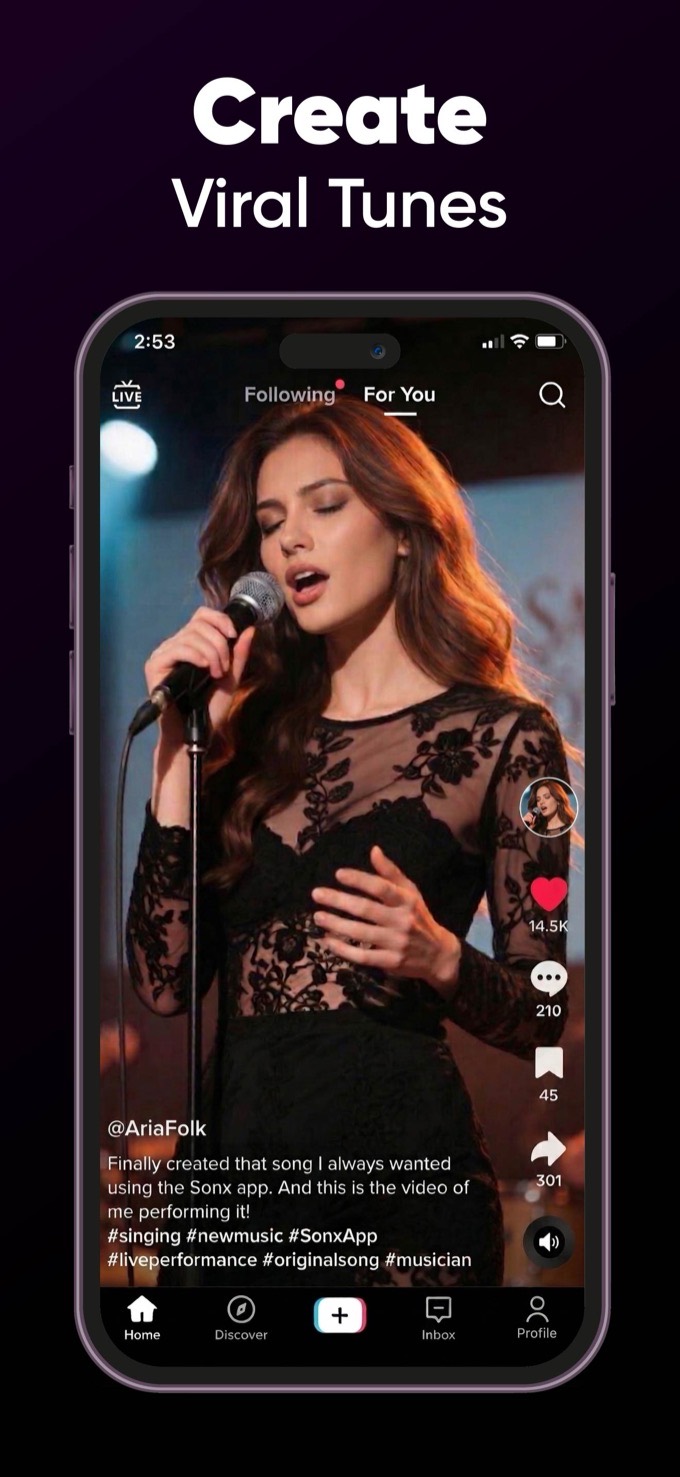
This is the single biggest argument for making the song and the video in the same place. When you generate a track in one app and then fight with a separate video editor to line the visuals up to the beat, the timing is where everything falls apart, and it's tedious enough that most people just don't bother. Making them together is the entire reason this is one of the features we pushed hardest on. We wrote more about that trade-off in our honest comparison of the AI music apps, including where we don't win.
Make the song and the video in one go
Sonx turns one sentence into a track, then generates a vertical music video timed to it, all created and downloaded from your phone, ready to post. Free on iOS and Android.
A worked example, start to finish
Let's run the whole thing on one sentence so it's not just theory. Here's the prompt:
"A euphoric hyperpop track about finally blocking your ex, built around one chant-able line."
Genre and style: hyperpop. Mood: euphoric, which is the interesting choice here, because the obvious mood for a breakup is sad, and euphoric is funnier and more postable. Subject: finally blocking your ex, specific and relatable and a little petty. Hook directive: one chant-able line. Four jobs, one sentence.
Now the steps after you hit generate:
- Generate two or three takes and pick the one whose hook hits fastest, not the one with the cleverest verse. You're choosing a hook, not a song.
- Trim to the front. Keep the hook and the first few lines, roughly the first 20 seconds. That's your clip.
- Make sure it loops. End on the hook so a replay drops you back into the chant instead of into silence.
- Generate a vertical video timed to the beat. For this one, fast cuts on the hook, something with motion.
- Caption it with the hook line itself. The on-screen text and the lyric are the same words. That's what gets typed into comments.
Total time, once you know what you're doing, is a couple of minutes. The first time we watched someone outside the team do this start to finish, the bottleneck wasn't any single step, it was deciding which of three good hooks to keep. That's a much better problem to have than staring at a four-bar intro wondering why nobody's watching.
The mistakes that quietly kill a post
Most failed short-form songs fail for the same handful of reasons. None of them are about talent.
- The intro. Any intro at all is usually too much intro. If the vocal hasn't started by the first second, you've already lost most of the audience.
- A hook that's clever instead of catchy. Clever reads well on a lyric sheet. Catchy survives a phone speaker and a moving thumb. When they conflict, pick catchy.
- A video stapled on after the fact. If the visuals don't move with the song, the whole thing reads as low-effort even when the song is good.
- No loop. A hard ending throws away the free replays that automatic looping would have handed you.
- Over-production. A dense, busy mix that sounds great in your headphones turns to mud on the device almost everyone will actually hear it on. Leave space.
None of this guarantees anything. Plenty of perfectly built songs get four views, and the occasional terrible one gets four million, and anyone who claims a formula for the second kind is lying to you. What the rules above do is make sure that when a song could have worked, a fixable mistake didn't quietly kill it. The rest is volume. Make a lot, post a lot, and let the ones that land tell you what to make next. We do the same in public on the Sonx TikTok, if you want to see which ones land and which ones very much don't.
That's the part the tool genuinely changes. When a finished song plus a matching video takes two minutes instead of two weekends, you can afford to be wrong nine times out of ten. If you want to start, Sonx is free on iOS and Android, and the rest of the journal goes deeper on the how and the why.